Contents
- Who your real competitors are on google.com.sa
- The backlink gap, done properly
- The keyword gap that surfaces striking-distance wins
- The 24/7 change monitor
- Case study: a Riyadh Salla merchant vs. noon
- News verticals: Al-Riyadh, Sabq, Okaz, Al-Sharq
- B2G: my.gov.sa and Vision 2030 microsites
- Semalt vs. Ahrefs vs. Semrush vs. Sistrix
- FAQ
Who your real competitors are on google.com.sa
Ask a Riyadh brand marketer who their competitors are and you'll get a list of three or four familiar names. Ask google.com.sa the same question — by extracting the top 10 organic results across the 500 highest-value queries in the vertical — and the list is almost always different. A jewellery brand in Riyadh usually finds that seven of its ten highest-overlap SERPs are actually dominated by Salla merchants they'd never heard of, not by Damas or L'azurde. An electronics reseller finds that jarir.com and noon.com dominate 80 % of the informational SERPs but only 34 % of the “افضل / مقارنة” comparison queries — where a specialty site could win in three months.
Semalt runs this analysis automatically. Feed your domain, pick a language (ar-SA, en, or both), and the platform returns a ranked list of your top 25 SERP-overlap competitors, along with a per-competitor overlap score and a “beatability” score based on their DR, content freshness and technical health.
Two lists, not one
Semalt always returns competitors split into two lists: strategic (rivals for your brand keywords — usually smaller specialists) and SERP (rivals for your commercial keywords — often huge portals like noon or jarir). The right response to each list is completely different. Confusing them is one of the reasons in-house KSA teams over-invest in fighting noon.com on head terms they cannot win.
The backlink gap, done properly
A backlink gap tells you which domains link to your competitors but not to you. Every tool advertises this feature. Almost every tool gets it wrong for KSA in two ways: (1) they include obviously spammy .xyz and .info farms, and (2) they don't understand Arabic-language editorial signals so they rank a private link from a real Sabq article below three garbage exchanges from a Kazakh directory.
PBN and spam filter
Cross-referenced against a 4M-domain deny-list of known PBNs and link farms, updated weekly by the Semalt trust team.
KSA editorial weight
Links from Al-Riyadh, Sabq, Al-Sharq, Argaam, Sabq360 and the ministerial press-release network score 3-8× higher than a generic DR-40 link.
Anchor-text intent
Anchors are classified as branded, generic, or exact-match, and the gap report explains what the mix says about ranking headroom.
Velocity check
A rival's link velocity is compared against organic-traffic velocity to distinguish real growth from paid link-building.
The keyword gap that surfaces striking-distance wins
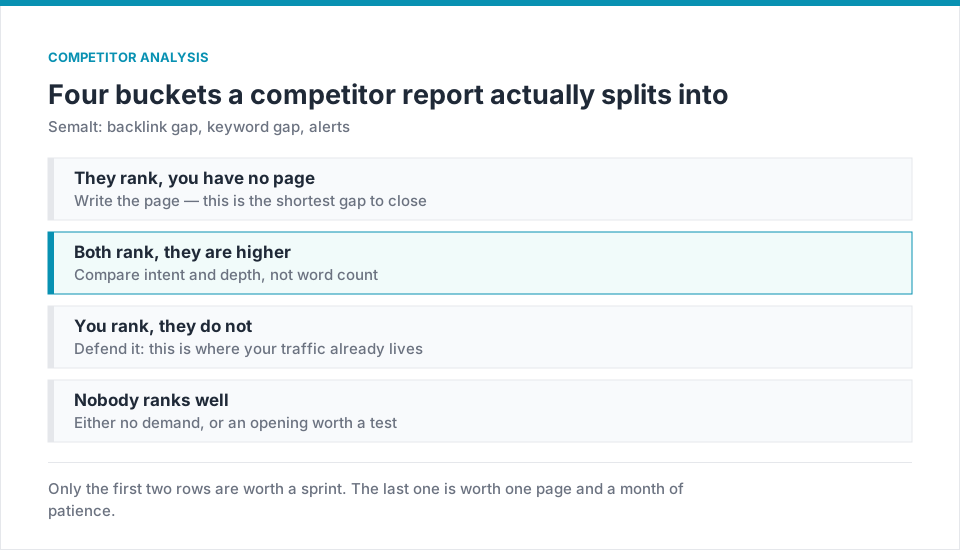
The keyword gap is where most of the money is. Semalt returns four sub-lists per competitor:
- They rank, you don't (at all). Pure gap. Sort by predicted SAR.
- They rank top 3, you rank 4-15. Striking-distance. Usually a content refresh, not a new page.
- You both rank, they earn more per session. Intent mismatch on your side — usually a landing page pointed at the wrong query.
- You rank, they don't. Your defensible moats — feed these into your PR and internal-linking strategy.
Every row includes the AR / EN split, the dialect classification (Najdi, MSA, Hijazi), the SERP features currently live on google.com.sa, and a predicted SAR/month uplift if you closed the gap.
Typical Riyadh Salla merchant vs. noon.com (Q1 2026 snapshot)
The 24/7 change monitor
What competitors did last week is more actionable than what they have overall. Semalt's monitor watches every competitor domain on a 15-minute cadence for four kinds of change:
SERP change signals
- New URL enters top 10 on google.com.sa
- Existing URL drops 3+ positions
- SERP feature appears above competitor (map, PAA)
- Featured snippet swaps hands
- New Arabic query starts driving clicks
Site-change signals
- New page published on a tracked domain
- Page updated (content diff > 30 %)
- New backlink from a KSA editorial source
- New Product schema pattern rolled out
- New hreflang variant added (ar-SA ↔ ar-KW)
Every alert lands as a Slack, Teams, Telegram or email notification with the URL, the change diff and a suggested response. It is the closest thing SEO has to a Bloomberg Terminal, tuned for the Riyadh SERP.
Case study: a Riyadh Salla merchant vs. noon
A Riyadh-based Salla merchant in the home and kitchen category, launched in Q4 2024, ran a Semalt competitor analysis in January 2026 against noon.com's home-and-kitchen subtree. Findings on day one:
- 18,600 keywords where noon ranked and the merchant did not. Total predicted uplift if fully closed: 412,000 SAR/month.
- The gap was concentrated in bundle keywords and “افضل / مقارنة” comparison keywords — both weak points for noon's templated PDPs.
- 318 striking-distance keywords where the merchant already ranked 4-15 and could reach top 3 with a content refresh. Predicted uplift: 96,000 SAR/month.
- 44 keywords defended exclusively by the merchant, largely brand-name Salla search patterns.
The team built a 45-day plan focused on the striking-distance list and one comparison hub. By day 60, 187 of the 318 striking-distance keywords had moved into the top 3. Organic pipeline attributable to the plan — measured via Semalt Analytics — was 73,400 SAR/month, a 3.1× return on the platform subscription in the first quarter.
SERP volatility check 2026: the average Salla-category SERP on google.com.sa reshuffles top-10 positions once every 6 days. Anyone auditing competitors on a monthly cadence is looking at a picture that is already stale. Semalt's 15-minute cadence surfaces the actual movements.
News verticals: Al-Riyadh, Sabq, Okaz, Al-Sharq
Publishers face a different competitive picture. Al-Riyadh, Sabq, Okaz, Al-Sharq, Al-Watan and Argaam trade top-3 SERP positions on breaking news within minutes. The winners are the outlets that publish fastest, structure their AMP correctly, and hold News schema. Semalt's competitor monitor is often run at 5-minute cadence for publishers, and its News-vertical report ships extra fields: TTFB from Riyadh POP, first-paragraph freshness, and NewsArticle schema validation.
What Semalt catches for publishers
- Top Stories carousel entry / exit
- Discover impressions vs. peers
- Twitter card completeness
- AMP validity per URL
- News sitemap freshness lag
What generic tools miss for KSA publishers
- Top Stories position on ar-SA
- Discover surface on Android Arabic
- Real INP on Sabq template
- Newsroom TTFB from Riyadh
- Hijri date freshness on templates
B2G: my.gov.sa and Vision 2030 microsites
Suppliers competing in the B2G space have a very different SERP dynamic. Most winning queries include a ministry name or a Vision 2030 initiative name (NEOM, THE LINE, Trojena, Qiddiya, Diriyah Gate, Red Sea Global, ROSHN, Green Riyadh). Semalt's B2G filter isolates only these queries and tracks the small pool of dominant suppliers competing in each initiative.
The B2G ranking function
Winning a Vision 2030 supplier keyword often comes down to a single high-authority editorial link from Argaam, Al-Riyadh or a ministry press release, plus a compliant Arabic case study on the supplier's own site. Semalt maps the whole chain automatically and flags exactly which link is missing on your side.
Semalt vs. Ahrefs vs. Semrush vs. Sistrix
Ahrefs
USD 129+ / mo- Largest backlink index
- Good UX
- Solid SERP overview
Gaps: weak editorial-weight scoring for KSA, no SAR uplift.
Semalt Competitor
From 0 SAR- google.com.sa first index
- PBN / spam filter tuned for KSA
- Editorial weight for Al-Riyadh / Sabq / Argaam
- 15-min change monitor with Slack / Teams / Telegram
- SAR uplift per gap row
- News + B2G verticals built in
Semrush + Sistrix
USD 200+ / mo combined- Strong domain visibility index
- Nice historical views
- Solid position tracking
Gaps: aggregates KSA into “Middle East”, no B2G intent filter.
| Capability | Semalt | Ahrefs | Semrush |
|---|---|---|---|
| google.com.sa specific index | ✓ | Global blended | Middle East blended |
| PBN / link-farm deny-list (KSA-tuned) | ✓ | Partial | Partial |
| Editorial weight for Al-Riyadh / Sabq / Argaam | ✓ | No | No |
| 15-minute change monitor | ✓ | Daily | Daily |
| SAR uplift per gap row | ✓ | No | No |
| B2G / Vision 2030 intent filter | ✓ | No | No |
| Salla merchant profiles | ✓ | No | No |
For pure link data volume, Ahrefs is still world-class. For Saudi competitor analysis that a CMO can read on a Monday and a content team can execute on a Tuesday, only Semalt currently ships the combination of google.com.sa focus, editorial weighting, 15-minute cadence and SAR pricing.
“We stopped chasing noon on head terms and went after 318 striking-distance keywords instead. Two months later, 187 of them were top 3 and organic pipeline was up 73k SAR/month.”
— e-commerce lead, Riyadh Salla merchant, home & kitchenMore in this series: Semalt Analytics: what GA4 hides from you, Semalt AutoSEO: on-page fixes without a dev, AI keyword research: revenue before volume.
FAQ
How does Semalt define a “competitor”?
By SERP overlap on google.com.sa specifically. We build the top-25 list from the 500 highest-value queries in your vertical and rank by shared appearances weighted by predicted SAR — not by domain-similarity heuristics that end up returning noon.com for every retailer.
Can I track a private competitor (small Salla merchant)?
Yes. Any indexable domain on google.com.sa can be added as a tracked competitor. Semalt does not require API access to their site — only the public organic footprint. Add up to 100 tracked competitors on the Growth plan.
How is “editorial weight” calculated for KSA links?
A trust model trained on 240,000 hand-classified backlinks from Riyadh and Jeddah publishers. Editorial links from Al-Riyadh, Sabq, Al-Sharq, Argaam and ministry press networks score 3-8× a generic DR-40 link. Comment-farm links score close to zero.
Does the change monitor work for JavaScript-heavy competitors?
Yes. Every crawl runs a real Chromium 128 headless browser, so competitors on Next.js, Nuxt or SvelteKit render fully before diffing. The diff engine ignores boilerplate changes (nav, footer, tracking) and only alerts on content and structured-data changes.
Can I export the gap into our team's tooling?
Yes. One-click export to CSV, Google Sheets, Notion, Airtable, Jira, ClickUp, Asana and monday.com. Or hand-off to Semalt AutoSEO to auto-generate the content briefs for the striking-distance list.
Does it separate google.com.sa from google.com results?
Yes, and it treats them as distinct SERPs by default. Most KSA brands rank differently on the two indexes, especially for English queries where Saudi expats might use google.com but Saudi nationals stay on google.com.sa. Semalt reports both and shows you which index carries the revenue in your case — usually google.com.sa for consumer verticals, mixed for B2G and enterprise.
What time zone are the alerts sent in?
Asia/Riyadh by default. Change-monitor cadence, reporting digests and email schedules all respect it, so a nightly digest arrives at 07:00 Riyadh instead of at some Berlin-friendly time that lands in your inbox during Fajr.
Run a competitor gap this afternoon
Add your domain and pick three rivals. Semalt returns the backlink gap, keyword gap and content gap in ten minutes, priced in SAR/month.
Open competitor analysis →