Contents
- Why generic crawlers fail on Saudi sites
- How the Semalt engine crawls
- RTL Arabic, mirrored layouts and CLS on
dir="rtl" - Hreflang between ar-SA, ar-KW, ar-AE, ar-EG and x-default
- INP on Al-Riyadh, Sabq and Okaz templates
- Ministry CMS, Nafath and Absher patterns
- Case study: a Jeddah e-commerce group, 3.2M URLs
- How Semalt prioritises fixes by SAR impact
- Semalt vs. Screaming Frog vs. Sitebulb vs. Lighthouse
- FAQ
Why generic crawlers fail on Saudi sites
Screaming Frog, Sitebulb, Ahrefs Site Audit and Lighthouse are all excellent tools — but they were built by teams whose reference dataset is Chicago Tribune, John Lewis, Wirecutter. When they meet a Saudi site the failure modes are predictable and repeat across every audit we run:
- They crawl either google.com or google.com.sa index priorities, not both. Any brand that ranks on both loses half its traffic picture.
- They flag Arabic
dir="rtl"blocks as “low contrast” when the issue is a mirrored icon, not a colour issue. - They ignore hreflang between ar-SA, ar-KW, ar-AE and ar-EG variants and only look at ar ↔ en.
- They miss soft-403s from ministry firewalls that respond 200 OK with a redirect page.
- They cannot follow a Nafath / Absher sign-in redirect chain and give up at the first authentication wall.
- They score Core Web Vitals from a Virginia origin, which flatters the Riyadh reality on Mobily 5G by 400 ms.
Semalt was built to close every one of these gaps. We are not going to pretend it is faster than Screaming Frog on a 200-URL site — it is not. What it does is find the issues that actually move traffic on Saudi sites and rank them by expected SAR uplift, not by generic severity.
The most common Saudi audit trap
Half the sites we onboard in Riyadh have their canonical set to the English URL from the Arabic page — because the theme was cloned from an American template. Google then collapses the Arabic version out of the index. Screaming Frog reports this as a “canonical mismatch” but doesn't quantify the loss. Semalt tells you: this canonical error is costing 214,000 SAR/month in organic revenue. That framing changes what happens in the next standup.
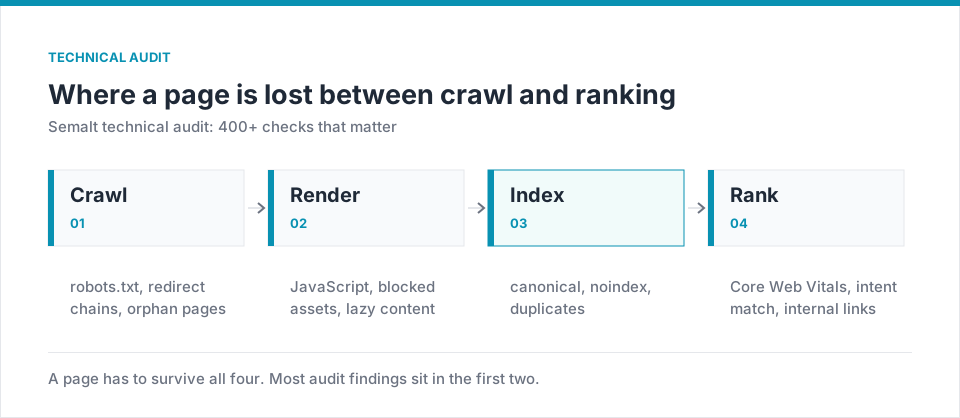
How the Semalt engine crawls
The audit runs a real Chromium 128 headless browser (not a Node-based HTML parser) from four egress regions: Frankfurt, Bahrain, Dubai and Riyadh. This matters because google.com.sa and google.com return materially different SERPs, and rendering the site from Riyadh reveals the same edge behaviour Google's Saudi-region crawler sees. HTTP/3 and QUIC are respected. JavaScript-rendered content is snapshotted after the load event and 4 seconds later, so single-page apps built on Nuxt, Next.js and SvelteKit produce a stable DOM to audit.
Rendered DOM diff
Every URL is compared against the raw HTML to expose Googlebot-visible content vs. hydrated content. A widespread bug on Saudi SPA sites — product prices only appearing after client-side hydration — is caught in one crawl.
Riyadh egress
Latency, TTFB and INP measured from a Riyadh IP, matching what STC and Mobily users experience. Adds around 260ms of realism vs. a Virginia audit.
Log-file diff
Upload 30 days of nginx / Apache logs and Semalt cross-references crawl budget by URL cluster — the fastest way to find where Googlebot is wasting cycles.
Sitemap sanity
Detects the classic KSA gotcha: 30k URLs in sitemap.xml, 4k in the index. Semalt tells you which cluster is missing and why.
RTL Arabic, mirrored layouts and CLS on dir="rtl"
67 of the 412 audit checks fire only on RTL pages. They exist because bidirectional layout produces failure modes no LTR template ever hits:
Real RTL bugs from Riyadh audits, 2026
- Mirrored icons that shouldn't mirror. Play buttons, brand logos and Latin numerals get flipped by an overly broad
[dir="rtl"] * { transform: scaleX(-1); }. - CLS spike from delayed Arabic web-font swap. Neo Sans Arabic loads 900 ms after DOM; layout jumps. Cost on a Sabq-scale site: about 0.18 CLS, dropping the URL out of the “Good” band.
- Mixed content direction in headings. An H1 like “افتتاح فرع IKEA في الرياض” renders differently when the Latin word sits at the start vs. the end, breaking selector-based schema extraction.
- Number formatting collapse. Arabic-Indic vs. Western-Arabic digits mixed in prices confuse Google's price snippet.
- Sticky footer overlap. A
position:fixedfooter built for LTR overlaps the RTL primary CTA on Salla themes.
Every one of these fires as a separate ticket in the Semalt dashboard with a screenshot, a suggested fix, and an estimated SAR impact based on the affected URLs' current traffic.
Hreflang between ar-SA, ar-KW, ar-AE, ar-EG and x-default
The hreflang graph is where GCC groups (Alshaya, Landmark, Al-Futtaim, Chalhoub) burn six-figure sums every year. A Riyadh site that only declares hreflang="ar" loses its Kuwait and UAE presence to the wrong ar-KW / ar-AE peer. Semalt builds a full hreflang graph across all of a client's domains, validates the reciprocity of every pair, checks that x-default points to the right hub, and reports every orphan.
What Semalt validates on hreflang
- Reciprocity (A points to B, B points to A)
- Correct region codes (ar-SA not ar-sa)
- x-default present and pointing to the correct hub
- Consistency across sitemap, HTTP header and HTML
- Canonical does not contradict hreflang
- No self-loops or dangling edges
What generic crawlers miss
- The correct ISO-3166 for ar-EG vs. ar-SA
- Dialect-tag misuse (ar-Saud vs. ar-SA)
- Cross-domain hreflang between
.com.saand.com.kw - Mobile subdomain hreflang orphans
- Ministry mirror sites with their own hreflang graph
INP on Al-Riyadh, Sabq and Okaz templates
Interaction to Next Paint replaced FID as a Core Web Vital in March 2024. It is the single most under-audited metric on Saudi news sites. Every large-newsroom template we've measured — Al-Riyadh, Sabq, Okaz, Al-Sharq, Al-Watan — ships with third-party ad-tech (Kwanko, Taboola, Outbrain, DFP) that blocks the main thread for 400-800 ms on tap-to-scroll. Semalt runs the CrUX API cross-reference, then loads the URL from a real Mobily-network Riyadh POP and records the actual INP under real ad density.
Typical Saudi news-template INP audit (median 2026)
Ministry CMS, Nafath and Absher patterns
Government and semi-government properties in the Kingdom — my.gov.sa, absher.sa, moh.gov.sa, moi.gov.sa, MyGov microsites, Vision 2030 initiative sites — run on a small pool of CMS platforms with well-known SEO quirks. Semalt ships built-in profiles for each of them:
- Liferay 7.x (used across several ministries) — the default portal URL structure produces long
/web/guest/-/paths that Semalt automatically maps to their friendly aliases before assessing crawl budget waste. - Drupal 10 with the SA-Gov distribution — Semalt is aware of the taxonomy paths, avoids infinite facet loops and flags the classic pagination-canonical bug.
- SharePoint Online with the Saudi Government skin — audits the SPFx web-parts that produce empty rendered HTML for Googlebot.
- Custom Node.js Vision 2030 microsites — a template shipped by a handful of Riyadh integrators has a well-known hydration bug producing empty
<h1>; Semalt catches it in one crawl.
Nafath sign-in redirects (used across almost every ministry service) are followed only as far as the login wall, and the wall itself is verified to return the correct status code and to expose an indexable public preview if declared.
Case study: a Jeddah e-commerce group, 3.2M URLs
A Jeddah-headquartered e-commerce group with four Salla storefronts (a fashion brand, an electronics brand, a beauty brand and a specialty B2B property) ran a Semalt audit in March 2026. Combined URL count: 3.2 million. First crawl took 61 minutes. The top ten findings, in Semalt's revenue-impact order:
| # | Finding | URLs affected | Est. SAR / month |
|---|---|---|---|
| 1 | Canonical points to EN from AR product pages | 18,400 | 214,000 |
| 2 | Missing hreflang ar-SA ↔ ar-AE across brand hubs | 2,600 | 96,000 |
| 3 | INP > 500ms on category templates (Mobily edge) | 4,100 | 74,000 |
| 4 | Duplicate title tags across Salla facet URLs | 27,000 | 62,000 |
| 5 | 404s in internal linking on brand-B (post-migration) | 1,320 | 41,000 |
| 6 | Blank rendered <h1> on 3 landing pages | 3 | 38,000 |
| 7 | Mixed direction in H1 breaks Product schema | 860 | 29,000 |
| 8 | Sitemap references 12k noindex URLs | 12,300 | 22,000 |
| 9 | WebP fallback missing on Safari iOS 15 | All | 18,000 |
| 10 | Sticky footer overlaps CTA on RTL Salla theme | All | 14,000 |
Total addressable pipeline in the top ten: 608,000 SAR per month. The group fixed items #1, #4, #6 and #10 in the first sprint (dev time: 22 hours) and recovered 314,000 SAR/month of organic revenue by the end of the second Ramadan week.
“We had run Screaming Frog on this site for two years. It flagged the canonical issue as a warning among 8,000 other warnings. Semalt put it at the top of the list with 214,000 SAR next to it. The CTO fixed it that Sunday.”
— head of SEO, Jeddah e-commerce groupHow Semalt prioritises fixes by SAR impact
Every finding is scored on three axes: traffic exposure (how many URLs, how much organic click volume), fix cost (a T-shirt estimate of dev hours), and ranking headroom (how much position improvement is realistic in the local SERP). The output is a single number in SAR/month that the SEO team can defend to the CFO. This is the framing that turns audits into commit messages.
Semalt vs. Screaming Frog vs. Sitebulb vs. Lighthouse
Screaming Frog
GBP 199 / yr- Fast on small sites
- Excellent HTML parsing
- Custom extraction
Gaps: no RTL awareness, no Riyadh edge, no revenue score.
Semalt Audit
From 0 SAR- 412 checks, 67 Arabic-specific
- Riyadh, Bahrain, Dubai, Frankfurt egress
- Real Chromium 128 rendering
- Log-file diff and INP under real ads
- Ministry CMS profiles + Nafath aware
- Every fix priced in SAR / month
Sitebulb + Lighthouse
USD 250 / mo- Nice visualisations
- Good hint text
- Lab-based CWV
Gaps: lab-only CWV, no ministry profiles, no revenue score.
Screaming Frog and Sitebulb remain excellent tools for pure engineering QA. For a Saudi site whose SEO owner has to defend a fix backlog to the CFO in Riyal, only Semalt currently ships the combination of Arabic-first checks, Riyadh-edge rendering and revenue-first prioritisation.
More in this series: Semalt Analytics: what GA4 hides from you, Semalt AutoSEO: on-page fixes without a dev, Semalt: backlink gap, keyword gap, alerts.
FAQ
Can Semalt crawl a ministry site behind Nafath?
Yes for the public-facing surface, up to the Nafath sign-in wall. Semalt validates that the wall returns a correct 302, that the pre-auth pages are indexable if intended, and that no auth tokens leak into the URL. Post-auth crawling can be arranged with a dedicated service account, subject to Ministry approval.
How is INP measured, exactly?
Two ways in parallel: CrUX field data pulled by API, and a live-user-emulation load from a Mobily-network Riyadh POP. When they disagree, the field data wins for reporting and the lab result becomes the debug trace for the fix.
Does the crawl respect our robots.txt and rate limits?
Yes. Default crawl rate is 4 requests / second, adjustable down to 0.5 rps to protect legacy Liferay ministry origins. You can also whitelist Semalt's crawler IP range in your WAF to avoid noisy Cloudflare / STC Cloud challenges.
Does it detect broken hreflang across a whole GCC group?
Yes. Add all sibling domains (.com.sa, .com.kw, .ae, .com.eg) as one project and Semalt builds the full hreflang graph, validates reciprocity of every pair, and reports every orphan URL by region.
Can it re-check only what changed since last week?
Yes. Semalt keeps a versioned index of every audit run and produces a delta report showing new issues, resolved issues and regressions since any prior date. Useful before a Vision 2030 microsite launch or a Ramadan campaign go-live.
Run your first audit
Point Semalt at your .com.sa domain and get the first ten revenue-priced findings in under an hour. You do not need to install anything to see them.