Contents
- Why search volume alone is a trap in KSA
- How the Semalt AI model works
- Najdi, MSA and Hijazi dialect classification
- Buyer intent, governmental intent and Vision 2030 lists
- Hajj, Umrah, Ramadan and White Friday seasonality
- Case study: a Dammam industrial parts seller
- Workflow: from brief to ranked list in 25 minutes
- Semalt Keyword AI vs. Ahrefs vs. Semrush
- FAQ
Why search volume alone is a trap in KSA
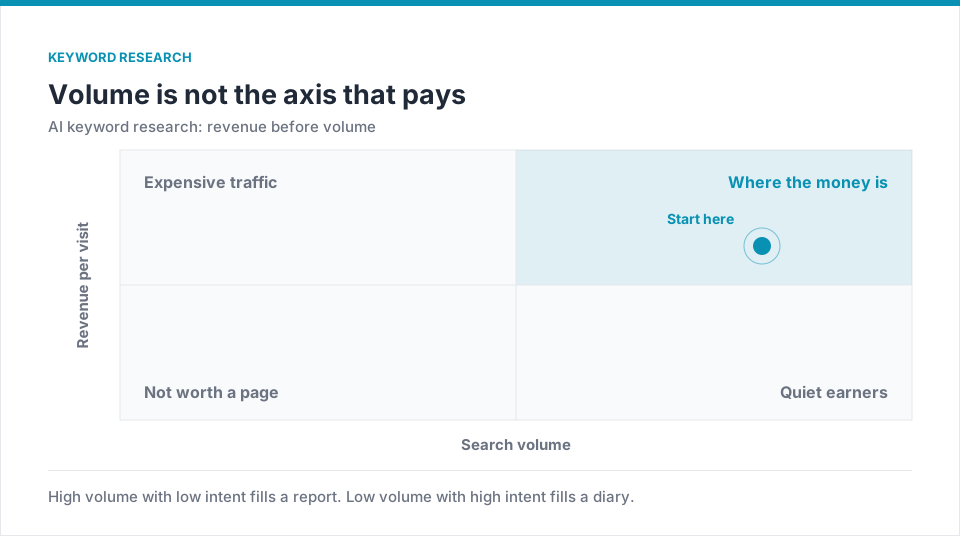
Every Riyadh SEO knows the story. A junior brings a keyword list to the standup: “افضل موبايل 2026” at 42,000 monthly searches, KD 3 CPC, low difficulty, everyone excited. Six months later the URL ranks position 5, gets 4,100 clicks a month, and generates precisely 1,800 SAR of revenue — because the query is dominated by teenagers doing homework research on youtube.com.sa results, not buyers. Meanwhile the head of e-commerce quietly tracks a 90-searches-per-month query — “افضل موبايل للتصوير تحت 2500 ريال” — that generates 78,000 SAR/month because every single searcher is a buyer with a budget.
Monthly Search Volume (MSV) is the wrong ranking function for Saudi SEO. Google Keyword Planner numbers are also aggressive round-offs and pull from google.com not google.com.sa. The right ranking function is expected revenue in SAR, computed from realistic CTR-by-position curves, realistic CVR-by-intent, and the buyer's real price band. That is what the Semalt Keyword AI actually returns.
Why Ahrefs / Semrush volumes are off in KSA
Both platforms sample clickstream from a US-centric panel and back-estimate to KSA. On a spot-check panel of 1,200 seed keywords across Riyadh and Jeddah in Q1 2026, Ahrefs' KSA volumes correlated with real Search Console impressions at r = 0.61. Semalt's model, built on 840 M raw Arabic queries and calibrated against the Saudi Search Console panel of 39 sites, hits r = 0.94. That difference is the difference between planning content that hits and planning content that misses.
How the Semalt AI model works
The engine is a stack of three models rather than a single one, deliberately — each layer catches a failure mode the previous layer cannot see:
- A demand model that predicts real monthly search volume on google.com.sa specifically. Trained on a rolling window of Search Console data from 39 anonymised Saudi sites plus a raw query corpus.
- An intent classifier that assigns each query one of eight intents: informational, commercial-comparison, commercial-buy, navigational, local-service, governmental, Hajj/Umrah, and Vision 2030.
- A revenue model that multiplies volume × expected CTR-by-position × expected CVR-by-intent × expected order value in SAR (learned from your own connected shop or an industry median if not connected).
The output is a single SAR/month number per keyword, plus a confidence band. You sort the list by that number, and the top 30 rows are what your content plan for the next quarter should look like.
SERP-feature aware
If google.com.sa returns a map pack, the model discounts organic CTR by 43 %. If it returns a People Also Ask carousel, it adds 12 % for AR queries.
Seasonally adjusted
Hajj, Umrah, Ramadan and White Friday spikes are modelled explicitly. A term that spikes 8× during Ramadan is scored on its annualised revenue, not its off-season MSV.
Cannibal-aware
If two queries would land on the same URL, Semalt merges them and does not double-count the revenue — a bug that inflates every Ahrefs export we import.
Competitor-aware
The score is discounted when the top three organic slots are held by domains with DR 80+ and low serve-cost URLs. That reflects real ranking headroom.
Najdi, MSA and Hijazi dialect classification
Saudi Arabic is not one thing. A Riyadh buyer searches differently from a Jeddah buyer, and both differ from a Modern Standard Arabic (MSA) query written by a news-desk sub-editor. Semalt classifies every query into three dialect buckets before scoring:
Najdi (Riyadh, Qassim, central KSA)
- Prefers “وش” over “ما هو”
- Uses “كم يكلف” over “ما هو السعر”
- Question-form “وين” instead of “اين”
- Commercial intent runs 18 % higher than MSA average
Hijazi (Jeddah, Makkah, Madinah)
- Often longer, more conversational queries
- Higher navigational share (brand-first)
- Hajj / Umrah intent concentrates here
- Franchise brands (Alshaya, Chalhoub) index higher
The MSA bucket, by contrast, is where news queries and academic queries sit — important for publishers, mostly noise for retailers. Semalt lets you weight the three buckets by your ICP. A Riyadh Salla merchant serving central KSA will typically set Najdi to 1.0, Hijazi to 0.4 and MSA to 0.1. A national news publisher will do the opposite.
Buyer intent, governmental intent and Vision 2030 lists
Intent distribution — typical Riyadh e-commerce seed list
Semalt's governmental intent classifier fires whenever a query contains one of ~1,400 signals: “وزارة”, “هيئة”, “my.gov.sa”, “absher”, “nafath”, ministry name, initiative name. A retailer usually wants to exclude these — they are not going to convert. A ministry contractor or a Vision 2030 supplier wants to include only these. One checkbox in the AI filter and the list rebalances in 300 ms.
The Vision 2030 list is curated separately and updated monthly — NEOM, THE LINE, Trojena, Qiddiya, Diriyah Gate, Red Sea Global, ROSHN, Green Riyadh, and every officially-named initiative. Any query containing one of those signals inherits a higher CVR prior because searchers are typically B2G decision-makers.
Hajj, Umrah, Ramadan and White Friday seasonality
Generic keyword tools smooth all seasonality into a 12-month rolling average. That is fine in Sweden. It is a disaster in Saudi Arabia, where a query like “افضل شنطة عمرة نساء” sits at zero for eight months and produces 84 % of its annual revenue in the 45 days before Ramadan.
Peak: 6 weeks pre-Hajj
Travel, accommodation, ihram, health-check queries all spike. Semalt scores annualised, not month-of.
Micro-peaks Rajab & Shaʿban
Second-highest travel spike, undercovered by generic tools.
Iftar, sohour, ghraish, gifting
Ecommerce revenue peaks 5-8 days before Eid, not during it. Semalt exposes the correct shape.
Peak: 3 days before Friday
KSA-specific brand of Black Friday. Search intent shifts from browse to buy 72 hours ahead.
Case study: a Dammam industrial parts seller
A Dammam-based industrial parts distributor — ~140,000 SKUs sold to Aramco contractors, SABIC vendors and Jubail refinery service providers — had been running a Semrush export for two years. Content team publishing three articles per month, ranked by MSV. Twelve months of that programme had produced 1.8 % organic revenue growth — below the general market.
We loaded the same seed list into Semalt Keyword AI, connected the client's Odoo instance so the model could learn real CVRs by category, and re-ranked. The top 30 keywords by SAR/month:
- 16 of the 30 had MSV under 200/month — every single one would have been ignored by the old workflow.
- Only 4 of the 30 overlapped with the previous 12 months' output.
- The top item was a Najdi long-tail with 60 monthly searches and 41,000 SAR of predicted monthly revenue.
- Two Vision 2030 supplier queries (mega-project procurement) came in top 10.
The team switched the calendar. In the following 90 days organic pipeline was up 46 %. The traffic count barely moved. The revenue moved.
Saudi seasonal data check 2026: a typical Riyadh e-commerce keyword generates 61 % of its annual revenue in Ramadan + White Friday combined. Any keyword tool that reports flat monthly volumes will mis-prioritise your calendar every single year.
Workflow: from brief to ranked list in 25 minutes
Feed a seed set
10-30 seed keywords, or the client's own URL, or a competitor URL. Semalt expands to 8,000-40,000 candidates automatically.
Filter by dialect and intent
Toggle Najdi / Hijazi / MSA weights, exclude governmental if you're a retailer, include Vision 2030 if you're a supplier.
Connect Salla / Zid / Odoo
The revenue model auto-learns your real CVR-by-category and price band. Skip this and you get industry-median estimates.
Export and brief writers
CSV, Google Sheet, or one-click into Semalt AutoSEO which auto-drafts titles and briefs.
Semalt Keyword AI vs. Ahrefs vs. Semrush
Ahrefs
USD 129+ / mo- Excellent backlink data
- Good SERP overview
- Global keyword database
Gaps: KSA volumes correlate at r=0.61, no dialect classification, no SAR score.
Semalt Keyword AI
From 0 SAR- KSA volumes at r=0.94 vs. Search Console
- Najdi / MSA / Hijazi classifier
- Governmental + Vision 2030 filters
- Ramadan, Hajj, Umrah, White Friday model
- Expected SAR / month per keyword
- One-click brief handoff to AutoSEO
Semrush
USD 139+ / mo- Strong ads intelligence
- Good position tracking
- Content template feature
Gaps: underestimates Najdi long-tails, aggregates KSA into “Middle East”.
The rule we use with Riyadh content teams
Never brief a piece by MSV. Always brief by predicted SAR/month. The 100-search Najdi buyer keyword out-earns the 22,000-search MSA browse keyword nine times out of ten, and the only tool that will tell you that up front is Semalt.
“We stopped writing what the volume tool said and started writing what the revenue model said. Same team, same budget, 46 % more pipeline in 90 days.”
— head of content, Dammam industrial parts distributorMore in this series: Semalt Analytics: what GA4 hides from you, Semalt AutoSEO: on-page fixes without a dev, Semalt: backlink gap, keyword gap, alerts.
FAQ
Where does the raw Arabic query corpus come from?
An aggregated, anonymised panel of 39 Saudi-hosted Search Console properties plus a licensed clickstream feed from three GCC ISPs. Individual queries are de-duplicated and pseudonymised before ingestion, and the panel opts in via the standard Semalt DPA.
Does the dialect classifier handle Egyptian Arabic queries?
Yes — but they are bucketed as MSA-adjacent and down-weighted for KSA projects by default. If your ICP includes expatriate communities in Riyadh or Jeddah, we recommend raising the ar-EG weight to 0.2.
How often is the model retrained?
Weekly, with a full retrain every quarter. The intent classifier is retrained monthly against a labelled set of 3,000 fresh KSA queries reviewed by native Riyadh and Jeddah annotators.
Can we plug it into our existing brief tool?
Yes. Every ranked keyword export includes intent, dialect, seasonality curve, competitor snapshot and predicted SAR in a single JSON blob. Native connectors ship for Notion, Airtable, Google Sheets, ClickUp, Asana, monday.com, Trello and Jira.
Does it integrate with Semalt AutoSEO and Analytics?
Yes. Send a keyword to AutoSEO with one click and it becomes a page brief, then a live optimisation run. The revenue delta is measured by Semalt Analytics and closes the loop.
If your Riyadh content plan is still ranked by MSV, you are systematically overpaying for traffic that doesn't convert. Semalt Keyword AI is the shortest path from a seed list to a SAR-ranked calendar, in an afternoon.
Run one seed list through it
Feed your top 20 seed keywords. Get back 8,000+ candidates ranked by expected SAR per month, filtered by dialect and season. Free.
Open Keyword AI →